Monday, March 28, 2011
Nothing 1000 Tacks Can’t Fix
I recently returned from a terrific four day Laser sailing clinic at Sailfit in Clearwater, Florida. I went with four of my regular sailing buddies, and all of us agree that we had a great time and learned a ton about laser sailing. It’s hard to say what the best parts of it were, but here is a list of choices:
• Small class of 6 people
• Entire group at more or less the same skill level
• How-to instruction from a bone fide expert and great teacher, Kurt Taulbee
• Individual, on the water coaching, one skill at a time
• Coaching to match our skill level and needs
• Video tape review of our sailing showing what we do well and what we do poorly
• Instruction on fitness and nutrition from another bona fide expert, Meka Taulbee
• Expert answers to every question we could think of
• Camaraderie with sailing buddies
• Warm water
• Escape from New England weather
Like many adult sailors and racers, I have attended my share of sailing seminars, heard one to two hour talks on the nuances of sailing a specific type of boat, and purchased a bookshelf of books and videos from experts and champions. Also like most adult racers, I have raced regularly, but practiced infrequently. I have sailed in some big regattas, trying to pick up tips and tricks from the experts, but I have not had any real coaching since the first “how to sail” lessons.
It’s amazing how much different getting some real coaching, especially from an expert, is from trying to improve sailing skills in the other ways. It is one thing to watch the champion on a video tape, but quite another to do what he does. Monkey see, monkey do has its limits. How do you know if you are doing what the champion did? Most of us can be pretty sure we’re not doing all of it, but what parts are we doing right and what parts are we doing wrong? What do we have to change? Kurt at Sailfit was great at sorting that out, and he has saved me years in trying to figure those things out myself.
I think he did the same things for all the other members of the group as well. His individualized feedback identified different strengths and weakness for each of us as we went through various skills. We each surprised ourselves a little in some of the things we did well. One of us could stand on the side deck and sail the Laser like an experienced surfer. The rest of us - not so good at that. Two others loved blind tacking. The rest - not so good at that. One could comfortably sail down wind, healed 45 degrees to windward right at the point of capsize. The rest looked more like old geezers. The process also revealed for each of us tendencies toward our own particular set of bad habits. We came away with individual lists of things to work on and Kurt’s voice in our heads telling us what we need to do to complete each skill better.
The last thing I came away with is Kurt’s response to fixing a bad habit or developing a new technique – “It’s nothing 1000 tacks can’t fix.” I don’t know if this line sticks with me because it appeals to a Midwestern hard work ethic or because it appeals to a high school coach who blows whistles through seemingly endless tacking drills. Whatever the reason, I know he’s right. But it begs the question “Are we willing to do the 1000 tacks?” Most sailors never really do them. We tend to read books and watch videos and “understand” it in our heads, but never really train our bodies to automatically execute the skills. We are also smart enough to realize that after the 1000 tacks, there are 1000 gybes, 1000 mark roundings (I suppose that’s really 1000 upwind and 1000 downwind), and 1000 starts (2000 in my case). Who’s got the time? It’s enough to make me really tired. Maybe 500 tacks are enough. Maybe 250. Oh god, I need a beer!
As soon as the weather is warmer and the wind is right and I have the time and……….., I’m going out and start those 1000 tacks. No, really. I’m going to try.
Sunday, March 13, 2011
Scooped!
Aside from the obvious entertainment value, the whole episode has an important lesson to teach about sailing.
The question is how to sail a laser without actually being in it. One possibility is to just fall off and let the boat sail itself. I’m sure that it takes remarkable skill to trim the sails and adjust the steering just right to keep the boat sailing after abandoning ship, but the better it is done, the longer the swim to ever get back together with the boat again.
A second possibility as one departs the boat is holding onto the mainsheet. The primary virtue of this approach is to stay in touch with the boat until it capsizes. (But, maybe there is another possibility. I wonder if it is possible to adjust the amount of body drag to achieve correct sail trim and keep the boat upright and going. Any volunteers to try this out?) Anyway…… this seems to be the preferred method so long as one holds on with the hands and does not wrap the line around arms, legs, or torso, which could cause some serious problems.
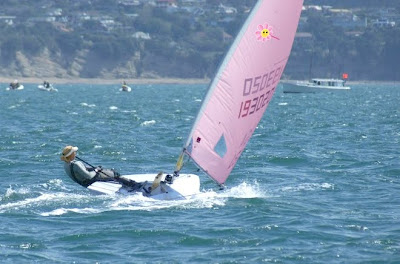
The third, but not very desirable method is holding onto the tiller extension. This seems to have been tried many times, and is apparently the best way to break a high performance carbon fiber tiller. Aluminum tillers don’t fare much better, except that they allow the sailor to stay connected to his boat. Holding onto the tiller extension was the method employed in the photo. It had two immediate results. The boat capsized (eventually) and the aluminum tiller looked like this:
Monday, March 8, 2010
Accidental Manly Men
As I suggested in the last post, one of the compensations for our manly acts of foolishness is the opportunity for a good story. Here is my personal big boat tale of stupidity and inexperience triggering my Man-Up instinct.
-------------------
At one point some years ago, I was a little bored with racing dinghies and thought I should expand my horizons to include comfy, cruising keelboats. I took a rather big first step and bought a used Pearson 36, a beautiful, comfortable, well made boat from a quality company… not counting some of the shitty lasers they made in an apparent sideline business. (Alas, they were driven out of business in 1991 by the recession and the introduction of a luxury tax on big boats.)
Admitting that a five day US Sailing course in bareboat cruising might not have taught me all I needed to know, when I picked up the boat I brought along an experienced friend who I will call Ralph Snodsmith. (No offense to any real Ralph Snodsmiths out there.) Because the new home of the boat was a full day’s sail from its current location, our trip began with some two hour jockeying of dry land transportation so that we would have a car waiting at journey’s end. The water part of the trip got underway in unusually calm Sippican Harbor in Marion, MA. As we motored out, it only seemed logical to raise the sails to be ready for Buzzard’s bay, known for its frequent 15 – 25 knot winds and 4 foot waves. As Ralph raised the main, it caught on a mysterious line, halting the process. The line appeared to go from a grommet on the luff forward along the boom. Not understanding the function of this line, we untied and removed it. Minutes later, another similar line became another obstruction and was handled in the same way. Finally, the main was up. Unfurling the 135% genoa followed efficiently. Geared up for the tumultuous Buzzard’s Bay, we found a sheet of glass. Humph. This never happens. Thank God for diesels.
The next segment of this under-powered power boat trip was through Cod Canal, passable only with a favorable current. Competent mariners for sure, we had timed this correctly. With apparent wind only generated by our movement, we kept the main up and furled the genoa. My first trip through the canal was smooth as silk.
To those of you anxiously awaiting the manly men part, thank you for your patience. It’s coming shortly.
On the Massachusetts Bay side, we finally found the wind we came for, a comfortable 8 – 10 knot off shore breeze. Finally the rumble of the diesel could be silenced and the peaceful beauty of travelling under sail power could be savored. Moving north at 5 knots on a close reach with flat water, life was very good. Man, was I smart to buy this boat!
Getting up to Plymouth Harbor, the wind had picked up to about 12, and boat speed went to 6 knots. It was really cool to have instruments that actually measured these things. In dinghies, we just make up these numbers by the seat of our pants based on our self proclaimed expertise and narrative needs.
Proceeding northward past Marshfield beach, the wind had built to a solid 15. The boat was heeled 18 degrees. (Measurement based on a crude tilt-o-meter and a poor memory… in other words, made up.) Half an hour later, the wind was up to 20 and the boat over to 25 degrees. (Same measuring system, but you get the trend.) Boat speed was about 7 – 8 knots. Boy, this was fun!
My experienced friend, Ralph, cautioned, “If this wind keeps building, we should think about reefing the sails.” Instead, we skipped any thinking and just enjoyed the ride for the next half hour as the wind built to 25 and the boat was over to 30 something degrees. Fifteen minutes later, we finally got serious and decided it was time to shorten sail. Ralph confidently wrapped the genoa furling line around the winch and began pulling. Nothing happened. Pulled harder, the line did not move. “The furling line must have jumped the spool. I’ll go forward and put it back on,” Ralph said calmly. I was in good hands.
As the wind had increased, it had moved forward. We adjusted to a close hauled course, and even with a short fetch from land, waves were starting to build. I was happy it was Ralph bouncing up there on the bow. It seemed he was up there for quite a while, and as he crawled back to the cockpit, I was hopeful that we were going to get this boat back to a more comfortable heeling angle.
“I couldn’t get it. The line looped over itself under the spool and I just can’t get it undone. We’ll be fine like this.”
“Maybe if we reef the main, it will help,” I said tentatively, trying to be helpful.
“Why not,” responded Ralph. “We’ll give it a try.”
We surveyed the situation. There were two grommets at the luff of the sail. All we had to do was to find some line to make an outhaul and lower the main
“Maybe we can use one of those lines we took off getting the main up,” I suggested.
“You know,” Ralph said thoughtfully, “those lines were tied to those grommets before I removed them. Maybe they were reefing lines.” (Doh!) “I’ll just retie them.”
Turns out that those reef points are pretty high off the cockpit seats when the main is up. Judging from the considerable reach of the 6’2” Ralph, the lower one must have been about 7 and a half feet up, just a little too high for him to get. (Aside: The nifty jiffy reefing system on the boat worked really well once I learned how to rig it properly.)
“We’ll be fine,” we told ourselves. “We can handle a little wind and the boat heeling over.” We were tough guys, manly men of the sea. Heeling over was not really a problem, only an inconvenience. The formidable weather helm just required a little muscle to keep the boat on course.
That eastern shore from the Cape Cod Canal up to Hingham where the boat was to be docked is a lot longer by sea than it is by car or appears on a map. Passing five towns may seem quite do-able, but these towns stretched for miles and miles. By 4 o’clock in the afternoon, we were just beginning to see parts of the third town, Scituate.
Now the wind was consistently in the high 20’s. We watched the anemometer readout, taking pride in our manhood with every gust. The highest was 33. We were pretty impressed with ourselves to be under full sail in this wind. At this point, the boat with a five foot freeboard had its rail buried in the water. No problemo. We could handle it.
As we approached Scituate harbor about 5:30, we noticed a lot of boats out. They had reefed sails. “Must be the Wednesday night race,” my knowledgeable companion observed. We were going to go right by them, affording a good view of the race. As we approached the fleet, we noticed a boat on the left reaching toward the other boats. From a distance, it was clear she was going to cross us with no problem. As we got closer, it wasn’t quite so clear that she was going to cross. Still nearer, it looked like it was going to be very close.
“Just to be safe, bear off and give him plenty of room,” Ralph suggested. With more speed we’ll cross him and give him plenty of room to go behind if he has to. Or we’ll just go parallel until it gets sorted out.”
With considerable effort, I turned the wheel to head down. When the boat didn’t respond, I turned harder.
“Let’s go! Turn down!” Ralph shouted with more intensity than usual. “It’s getting too close!”
“I’m trying! It’s not going!” (Funny how large boats behave like dinghies in this respect. Full sails in big wind completely overcome the rudder in steering the boat.)
By this time, all aboard the other boat were hollering at me too. They were in complete disbelief that some asshole just out cruising might actually hit them during a race. Sweating, I began imagining the shattering of fiberglass that would occur when a 15,000 pound boat going 7 knots broadsided another boat. As the boats came within a few boat lengths of each other, Ralph simultaneously yelled “tack!” and dumped the main. The dumping of the main allowed the ruder to take over just enough to turn the boat and avoid the stern of the other boat by five feet. The two of us finally exhaled, but the screaming from the other boat continued. We hung our heads in shame for causing the close encounter, but we also secretly prided ourselves on our quick reactions and heroic disaster avoidance skills.
Having a modicum of sense, we admitted to each other as we sailed on that our unfamiliarity with a new boat had caused considerable anxiety to everyone on both boats. But what could we have done? Under full sail in that wind, a big boat is really hard to handle. In the end, no one was harmed, no property damaged. No big deal.
Checking the time, we realized that there was no way we were going to reach our destination before dark. Our vast experience told us that navigating an unfamiliar harbor at night was a potentially bad idea. Besides, we were tired and really needed some beers.
Being the veteran sailors we knew ourselves to be, we radioed the harbor master and requested a mooring for the night. He gave us a mooring right on the channel, not allowing us to demonstrate our boat handling skills in tight spaces. Maybe he had already heard about us. After finally fixing the genoa spool, we stowed the sails and closed up the boat for the night.
As we rode the launch in, who did we pass but the sailors on the boat we narrowly missed. Fortunately, they did not recognize us as we turned our faces away in casual manly avoidance. However, halfway through our first beer, our would-be victims strode into the bar. We were going to have to meet this head on as real men do. After a friendly greeting, we apologized, offered to buy them a couple of beers, and laughed at our close call. We earned forgiveness, at least in our minds, at the very reasonable cost of two beers each.
We were, however, still 10 miles from the car we planed to drive home. Being single at the time, I had no one to call, and it would have been an admission of failure to ask Ralph’s wife to make a rescue trip. No biggie. Ralph said he would use his manly charm to find a ride back to the car. So effective was Ralph’s “charm” that it was actually one of our victims who located someone going our way – an absolutely shitfaced drunk. Not to worry. It was late, few cars still out, secondary roads.
It was, in fact, no problem. Our new friend was one of those highly cautious drunk drivers, never breaking 20 MPH all the way back to our car.
Getting into the car, we breathed a long, deep salt air sigh of relief and satisfaction. We had conquered a 33 knot wind without conceding an inch of sail area, we had avoided, nay prevented, a disaster, we had made new friends, and we had a good story to tell and perhaps embellish. A good day for two manly men of the sea.
Saturday, March 6, 2010
Why Manly Men Never Use a Radial Sail
For anyone who doesn’t sail a laser, I should first explain what a radial is. Lasers can accommodate three sizes of sail – full rig, radial, and 4.7 – each one getting successively smaller. The idea is that smaller and lighter people can step down the sail area and still sail with the same hull. It is also a way for sailors to deal with increasing wind by reducing sail area, just like every big boat in the world does. It would seem there is ample precedent for the wisdom of this concept.
Nevertheless, manly men never reduce sail on a laser no matter what the wind, their physical limitations, or their sailing deficiencies. (A few shorter, lighter, perhaps smarter men are notable exceptions to this rule, but they have Laser Radial World Championships to prove their prowess.) Below is a list of 6 excellent reasons why manly men continue to defy conventional big boat sailing wisdom and never cop out with a radial.
Radials are for girls. It’s simple in the Olympics – men sail full rigs, women sail radials. Period. End of story. It doesn’t matter how big or strong the women are or how small the men are. It’s a gender issue, and only girls sail radials. Gender identification can be a slippery slope, and no manly man wants to take even a first step down that slope.
Radials are too slow. Manly men always go for maximum speed. Being in control doesn’t matter. Even though the two sails become about equal upwind, downwind the big sail always goes faster if it stays upright. The more Adeline the better. Damn the consequences, full speed ahead!
Manly men aren’t chicken. Regardless of the amount of wind and the size of the waves, a smaller sail is an admission of fear. Fear is not acceptable in the code of the manly man. Even if every sailor on the beach understands that radial sails are just a common sense reaction to the conditions, no manly man wants to be the first to suggest it. He is understood by the others to have conceded that his thingie is smaller than the other guy's thingie.
The marks of a manly man are strength, courage, desire for adventure, and the ability to prevail over whatever comes. God bless you, manly men!
Thursday, February 18, 2010
Chaotic Waves
Sailing upwind, I had to unlearn some things. We flat-water lake sailors try very hard to keep the boat flat. But with waves, some heel (? 10-20 degrees) may be required to keep the waves from breaking over the windward bow, filling the cockpit, and to facilitate the heading up move as you rise up each wave. Bearing off at the top of the wave to slide down the other side doesn’t result in the lee bow plowing into water despite the heel because the bow is actually somewhat airborne at that point.
Waves often come from odd and constantly changing directions. You can frequently have large waves that are easily 45 degrees or more from the wind direction. On one tack upwind, the waves are broadside, but on the other tack, they are head-on. I found that often the boat was buffeted by the waves seemingly in a random fashion with rolling, pitching, and yawing - at least it seemed that way to me, especially on a beat. The sail luffs one second and is over-trimmed the next. I found myself madly trying to correct with the tiller which I’m sure was only making things worse.
I am still confused as to the best way to deal with these chaotic waves. Maybe I need to hike out more horizontally to increase the rolling moment of inertia and reduce the rolling. Maybe I should try to actively change my hiking to keep the heeling more constant. Maybe I should play the sheet more, and the rudder less. Maybe I need to better judge the approaching waves to make adjustments preemptively. I imagine that the best approach is different for each wind and wave condition.
Then I took a second look at the photo at the top of this post which I believe was taken shortly after a start. There is quite a bit of variation in the hiking styles and maybe a correlation between these hiking styles and the sailors’ positions in the race. I am embarrassed to note that I appear to be just casually sitting on the deck of my boat (133827 in the foreground). Maybe I just need to hike!
Although I know I’m just beginning to learn how to sail a Laser in waves, I do feel quite a bit more stable and comfortable now sailing in these conditions which was the main goal for the trip to Cabarete. I think I am able to time the tacks earlier so they are completed by the top of the wave if a flat spot to tack is not available. I know I must cross the boat very quickly and aggressively during both tacks and jibes to avoid capsizing and maintain momentum. I know how to sit in a more “locked-in” position while riding waves downwind and to simply steer left or right to avoid slamming the bow into the next wave. I know I have to stay more alert at all times. (Once I capsized while just resting before a drill because I didn’t notice a wave coming that crashed over me.) Putting it all together, I think I am nearing the point where sailing in waves will actually be fun!
Eric
Tuesday, January 26, 2010
Cabarete Waves
When I was first introduced to Laser sailing four years ago, Yarg, the creator of this blog, correctly told me that I would have to go through a painful initiation with a lot of capsizing before Laser sailing would become fun. I think there is a second painful learning process for us lake sailors when we try to start sailing in waves.
Last fall I took part in the New England Masters (age 35 and over) Laser Championship Regatta off Third Beach in Newport. There were light to moderate winds on Saturday, but Sunday brought 20 plus knot winds in open water with waves measured in feet, not inches like the ripples we have at our local lake. I capsized once in the first race, twice in the second (all on mistimed tacks), and three more times trying to get back to the beach (all death rolls). It was obvious that if I wanted to be able to sail and have fun at the major Laser regattas which are necessarily held on large bodies of water, I would need to get some experience sailing in waves.
Cabarete is also the home of the CaribWind Laser Training Center, an amazing facility, unique in the world. It seems to be focused on Laser Training for very advanced sailors including many Olympians, but it also worked out well for me despite my, shall we say, less advanced skill level. I recently attended a four day Laser clinic there, followed by a three day regatta. A typical clinic day included an hour or more of onshore class with videos and diagrams, three to four hours of sailing with a variety of drills, a quick and very welcome meal at the EZE-Bar/Restaurant on the property, and finally another hour or more of class. My hotel, the Velero Beach Resort, was excellent with all the amenities, great water views, an open air beachfront restaurant, and a very friendly and helpful staff. It was just a five minute walk down the beach to CaribWind.
Launching and retrieving boats at the Cabarete beach can be challenging. Despite some protection from an offshore underwater reef, there were often pretty decent sized breakers. Retrieving boats was typically done one at a time with the assistance three young guys in the water, one at the bow with the dolly, and one on each side to lift the stern over the breaking waves. The sailor had to remove the centerboard, lift the rudder, remove the main sheet, and jump out of the boat just before approaching the retrieving team. I saw one normally very robust Seitech dolly break in the process.
The emphasis of the clinic for these very good sailors was naturally on the many fine points of speed, boat-handling, tactics, etc. My emphasis, on the other hand, was trying to learn how to keep the masthead out of the water, and staying out of everyone else’s way while sailing in large waves, typically two meters or more. Still, I learned a lot. There were some very basic but critical things, like simply steering to one side or the other when surfing down a wave to avoid plowing head-on into the next wave, turning the Laser into a submarine, and filling the cockpit with seawater. By the way, by my calculations a Laser cockpit filled with saltwater weighs about 290 pounds.
Hasta luego.
Eric
Friday, October 16, 2009
RAD Sails
Thanks to the support of my Athletic Director and the town Recreation Director, my sailing team has a great new toy to play with - Intensity’s new RAD (reduced area design) 420 mainsails. In combination with a standard jib, these are a cross between storm sails and full size sails, with most of the virtues of both.These sails are a solution to a host of problems from both the coach’s and the sailors’ perspectives.
For the sailors, there is always a upper wind limit beyond which their performance diminishes rapidly. For newer and lighter weight sailors, this limit is reached pretty quickly. For experienced sailors, the limit is higher, but there are still several days each season that excessive wind causes us to sail badly or not at all.
From the coach’s perspective, repeated capsizes by the less experienced sailors undermine or prevent other organized group activities. Leaving some sailors on the shore makes running a practice or a meet manageable, but denies opportunities for the land-bound to expand their skills in the very conditions where they can move up to the next level.
RAD sails give us an opportunity to deal with all of this. We have now used them on several occasions, and I love them! They give us just the opportunities I was hoping for. The freshman can use RAD sails while the other sailors use full sails, making many of those questionable days very productive. We had one day with a weather forecast of gusts to 40 (they were actually never above the high 20’s) in which everyone used RAD sails. We only had one capsize, and the team got some much needed time in heavy and very gusty conditions. We now choose our sails to match the wind conditions and don’t miss any sailing time.
Intensity spent some time developing these sails and seems to have gotten it just right. They are small enough to keep more boats upright but don’t just function as a survival sail. The main is still large enough to use with a standard jib without throwing the boat out of balance. They are naturally a little slower than full sails, especially downwind, but they are not dogs. All of the same sail trim techniques used for the full sails apply when using RAD sails, but they are simply easier to handle and more forgiving. I think they will be very useful in the teaching process. Kids can develop skills of ease-hike-trim, feathering, and heavy air gybing with a little more margin for error, but they are also rewarded for successful sail handling. We have found that the sails are plenty powerful enough to get the boat on a plane.

The whole team is excited that we now have so few limitations on when we can sail, and the kids love that they can have the fun of sailing in the big breeze with fewer negative consequences. The coaches love that we have the flexibility to maximize sailing opportunities for everyone, while maintaining safety and managing the potential chaos. I think Intensity did a great job of developing a product that opens up sailing opportunities to newer, lighter sailors and to all sailors in heavy conditions. RAD sails are a terrific asset to our sailing program!RAD Sails
Friday, July 31, 2009
Oops!

I was just minding my own business before a start when I was attacked from behind by a run away Laser. The out of control boat leapt right over my transom and was stopped by my arm before it could do any real damage.
Thank God no boats were harmed!!!!
I know the other guy feels worse about this than I do. Maybe we should have both have a beer at the White House.
Friday, July 10, 2009
Whitewater Rafting – The Out-of-Raft Experience

Concurrent with Tillerman’s Write a Review group writing project, I planned a little rafting trip as an interesting activity during a visit with my dad in South Carolina. I thought the two would dovetail nicely, and I could write a simple review of the trip and the company who ran it, Wildwater, Ltd.
It should be made clear here that Mrs. Yarg and I are complete neophytes at rafting. She has never been, and I have been only once before. I should also confess that we are not thrill seekers or adrenalin junkies. Planning and surfing in sailboats is enough for me. As a couple, golf and the nature watching version of kayaking are fine with us; skydiving and rock climbing are not.
Anticipating doing the review, I began writing in my head. I found out later that that review had already been written by an Atlanta newspaper and appears on the Wildwater’s website, http://www.wildwaterrafting.com/. It contains all the basics:
- Wildwater Ltd. is widely considered one of the best commercial rafting outfits
- The trip has laughs, excitement, and splashy outdoor fun
- The guides are young Bohemians with an encyclopedic knowledge of the river
- All safety precautions are taken – PFDs, helmets, safety talk about feet first swimming and safety ropes
- The Chattooga is designated a "wild and scenic" river
- Rapids have colorful names like Corkscrew, Last Supper, and Deliverance
And everything in that review is correct. But our experience of the trip was more aptly described by our guide’s term – out-of-raft experience.
It all begins with the reservation when they ask which trip you want to go on. The question is: Class III rapids or class IV rapids? Our knowledge of rapid classes is limited to Meryl Streep running a class V in The River Wild. We don’t want that. One of the kids working in the office says, “You want the Class IV. Class III is a little boring.” Class IV it is.
I looked up the definitions later and this is a Class IV (italics are mine):
Class IV/Advanced..... Intense, powerful rapids; turbulent water; may involve long, unavoidable waves, holes or constricted passages demanding fast maneuvers under pressure; may require "must" moves above dangerous hazards; risk of injury to swimmers is moderate to high; group assistance to swimmers requires practiced skills
Other fun facts not fully appreciated at the time of registration:
- This is the river on which Deliverance was filmed
- The Chattooga contains the steepest section of river commercially rafted in the Southeast
- What I used to think of as small waterfalls are more properly classified as Class IV rapids
All through the safety talk, I am thinking these commercial rafters sure take all the precautions and cover all the bases, but overdo it a bit with a “scared straight” tone. Insisting that we wear PFDs and helmets to cushion falls in case we slip while walking on rocks while not rafting seems a bit much.
The first part of the trip on the river meets all expectations. There is excitement, splashing, and good wet fun. The guy next to me, Don, seems to have been rafting many times and wants all the excitement he can get. With a bump on a rock that is far from extraordinary, Don flies out of the boat into the cool water and seems to enjoy the unfettered ride until the burly guide deftly plucks him back into the boat.
Our guide’s path down the river seems a bit less expertly chosen than Meryl Streep’s or even Burt Reynolds’ and Ned Beatty’s, but I try to make some allowances for reality being different than movies. After getting stranded on submerged rocks a couple of times, and having the guide jump out to wrestle the raft free, Don says “I don’t think he’s the best guide.” After some casual questions from Don, the guide reveals that this is only his second year of rafting, but reassures us with a description of the rigorous training program for guides.
We follow rather simple paddling instructions as the guide does all the brain work and steering. “On this next rapid,” he explains, “everyone has to lean as far as they can to the right.” As the raft seems to climb a rock sideways just before a several foot drop off, we all lean hard right to counterbalance the tilt of the raft. The raft then does a 180, making right left, and we find ourselves leaning hard to the low side of the raft causing both Don and the guide to hurtle into the water. Unpinning himself from between the raft and the rocks, the gasping guide struggles to get the raft marginally under control as we do a spin or two while hauling in the swimmers.
Mrs. Yarg and I exchange concerned glances. We are beginning to worry that the brains and skills of the operation may not be as brainy and skilled as these two trusting neophytes had hoped.
I always thought of whitewater sports as an exercise of skill and grace through a turbulent and chaotic situation. I also thought the object of the game was to thread the raft between the rocks without hitting them. Apparently I was wrong. I have a new respect for the ruggedness and abrasion resistance of inflatable rafts.
As we approach what appears to be a rather long but manageable set of rapids, we watch the boat in front of us intentionally doing 360s down the rapids. As we enter the whitewater, the guide asks if we want to do 360s too. Mrs. Yarg succinctly says “no,” at which time the guide starts spinning us. At about 270 degrees, we roll up on a rock, and Mrs. Yarg and I are ejected over backwards into the river. Repeated capsizes in my Laser have taught me to remain calm in these dunking situations, but the ensuing rapid horizontal movement I experience is new and unsettling. I come up grabbing at the first thing I see which happens to be Mrs. Yarg who, fortunately, has succeeded in latching onto the raft. After floating at high speed with feet up to repel sharp objects and a few ricochets off sunken rocks, the subsequent yanking haul in doesn’t seem so bad. I suggest to the guide that perhaps 360s should be limited to a horizontal plane.
Unlike a sailboat capsize, I don’t see any of this coming. One second I’m in the raft, and the next second I’m upside down in the water. The thought that there are real risks involved in this is finally starting to sink in.
Now the guide is starting to preface his instructions for the upcoming rapids with “There is no reason to fall out of the raft, but when you do…” followed by instructions on which side to swim toward (as if one were in control) and where the rescue ropes will be. Rescue ropes? Yikes!
It turns out that the complete out-of-raft experience includes rescue ropes – beautiful thick yellow ropes thrown by skilled, heroic young men. Yep, you guessed it. The next launching at the second of the famed Five Falls is pictured below. My new best friend, Don, can’t resist diving over me as he, Mrs. Yarg, and I share a triple out-of-raft experience.

As I surface, I realize I am running the rapids without the benefit of a raft. I’m happy to see Mrs. Yarg surface nearby, but no blue rafts or rest stops are ahead on this highway. A golden voice comes out of the trees and shouts, “Catch this!” as that wonderful yellow rope drops two feet in front of me. Without needing additional encouragement, Mrs. Yarg and I lunge for the lifeline, me at the end and she, mid rope. I thought sure that she would provide the pivot point and I would be whipped into the jagged boulders at river’s edge, but our knight in shining PFD runs along the rocks to gradually slow us down until we reach a reasonable take out point. I have never seriously practiced throwing a coil of rope even though I know it might be useful in sailing rescues. I now have a new found regard for this awesome skill.
Nursing scrapes and bruises where thigh met rock and snorting the river water out of our noses, Mrs. Yarg and I shakily anticipate our next attempt to survive the fun we’ve signed up for. Standing on the rocks at the shore and looking at the waterfall I am about to go over is stimulating the fear instinct in me. I am not going to give into it, but all trust in our leader is shot, and the remaining two of the Five Falls are approached with some dread. The guide tells us that he will exercise all caution on the next two, and our approaches will be “textbook.” Why the hell didn’t we try textbook before this?
When there is real trouble ahead the guide hollers “Get down!” and we all duck toward the center of the raft. In this last section of the trip, we continue to cower with heads down long after the “get down” period is over. Somehow we survive the rest of the trip without incident. The guide's official final score for our five tourist raft is seven “swimmers“. (He doesn’t count himself, and the tourists’ count is higher.) I can see from his face that this is well above average. In talking to other guides I find out that the swimmer tally is highly variable, but I am left with the firm impression that the swimmer number should not exceed the passenger number.
In the end, it seems there are several versions of Wildwater Ltd. and their rafting excursions. I guess that’s what outdoor adventure trips are all about. I think that before my next trip I will share with my guide the view that the sport is more elegant when the driver avoids the rocks rather than hits them and when he keeps the passengers in the raft rather than out of the raft. I’m sure an occasional “out-of-raft experience” is an integral part of the sport, but surely there must be a more reasonable balance between swimming and boating.
Tuesday, June 2, 2009
Discretion is the Better Part of Valor
Sadly, that is not really me. I’m not in the shape I should be for serious or even semi-serious Laser sailing. I always mean to do something about that, but for a number of reasons, it doesn’t happen (Another list? Damn you and your lists, Tillerman!). I’m too short to get enough leverage to hike as successfully as others at my weight. I’m a little light for a full rig in a big breeze and a little too heavy for a radial. Examined positively, I’m an inbetween-er; examined less charitably, I’m an old, out of shape, chicken shit.
For a while now, I have been wondering at what point (wind velocity, not physical deterioration) I should switch to a radial. World Champion Great Grand Master, Peter Seidenburg’s advice to me was about 20 MPH, where he is as fast with a radial as the quality sailors with full rigs. I don’t play in his league, so I look at it as the point at which I sail faster with a radial than I sail with a full rig, and the point at which I have more have fun with the wind as opposed to getting beat up by it.
Sunday was another experiment with that quandary. After 20 minutes of wind evaluation (or really just indecision), the wind tended toward big, and I tended toward small, and picked the radial.
Two full rig guys dropped out before the first race. I got a great start against four full rig guys (and the Sunfish guy), but tried to tack in a big header, wrapped the mainsheet around my foot, over rotated the tack, and capsized. Less sail area doesn’t cure stupid or clumsy. Watching the race from behind on the downwind leg, I had a great view as a big gust death rolled one boat and then proceed down the course to capsize the leader just as he hardened up around the leeward mark. Back in the race, I just had an easier time keeping flatter, watching the squirrelly puffs and shifts, and generally keeping my head out of the boat than if I had been constantly fighting the wind. By the end of the second windward leg, I had passed the remaining hardy souls valiantly fighting the brave fight of full rig vs. big breeze. It ended up with only two lasers and the Sunfish guy left at the finish. My little radial won by a full leg of the course, and the Sunfish was only edged out at the finish by the laser who had capsized at the leeward mark. I love it when the little sail beats the big ones – when David beats Goliath.
That day, I made the right call. It seems that “old age and treachery” won out – “discretion was the better part of valor.” It just makes sense that as the boat approaches maximum hull speed, more sail area is no help. In Lasers, the flatter the boat up wind, the faster it goes. When it’s all I can do to keep flat with a radial, more sail would be a liability. Off the wind is another story. On a reach, the radial just can’t keep up. But most courses these days are windward leeward, and it seems that straight down wind the small sail isn’t much of a liability. For me it’s a question of keeping my head out of the boat. If a full rig produces enough boat handling difficulties to prevent looking back for the puffs or the waves, then it won’t be faster. Sailing the wind and the waves works much better for me than more power.
One of the really great features of the Laser is the ability to change sail area; we should take advantage of it more often. Every big boat sailor matches sail area to the conditions as standard operating procedure. Laser sailors, except for the big guys, have that option and should use it more… at least according to this old, out of shape, chicken shit.
Friday, May 15, 2009
12 Ways to Sabotage Your Start
At one time or another I have tried all of these, and they really do ensure a lousy start with a great view of lots of transoms.
- Never practice
- Don’t bring a watch
- Bring a watch that is so hard to set you only get it set at the 1 minute signal
- Ignore winds shifts, particularly lefties that crush you if you’re not up on the line
- Try the “squirrel” start in a good fleet (see Tillerman's Dead Squirrel)
- Start on port on a short line with a good fleet
- Start next to the best guy in the fleet so you can admire his technique as he squirts out under you or rolls you
- Try to win the boat to show those 10 other guys trying to win the boat that you are better than they are
- Try to “come in with speed” from behind a wall of luffing sails and disturbed air only to learn the there is no speed in disturbed air
- Luff the boat to windward, create a giant hole to leeward, and have the best guy in the fleet come in on port tack to fill the hole on your lee bow
- Be the first to get to the line, luff, stall, and then, while going backward, try to accelerate with 1 second to go
- Be the OCS boat at the committee boat that blocks the view of the other OCS boats who then avoid being called back
Monday, May 4, 2009
Learning to Embrace the Racing Rules of Sailing (RRS)
After coaching high school kids, watching them struggle with the RRS, and serving on too many protest committees for my liking, I observe a 7 stage process high school sailors follow as they simultaneously develop their sailing skills and try to learn and use the rules. It might be true for adults too, but probably with less yelling (in most cases) and a little more civilized behavior. Girls, with some notable exceptions, also follow the pattern with more civilized behavior.
- Intimidation. Both the rules and the more experienced sailors are intimidating. There are too many rules to learn, so the kids focus on three right of way rules - starboard port, windward leeward, clear ahead and clear astern. The only goal is avoiding collisions. In most situations the one who yells the loudest intimidates the other and gets right of way. Hollering “PORT” with enough authority is likely to get the starboard boat to forget the opposite tacks rule and to tack away, and the starboard boat is a long way from knowing about Rule 2, Fair Sailing.
- I’m not gonna take it anymore! Tired of being bullied, sailors figure out when they have right of way, and they have heard something about tacking too close and room at the mark. They are confident in their grasp of a few bits of the rules, don’t back down to loud yelling, and end up in the protest room talking about the rules they don’t yet fully understand.
- I AM the right of way boat! Empowered with the idea that they are the right of way boat, sailors command other boats to move out of the way while ignoring the sailing realities of clear air and the abilities of boats to change positions in real time and space. One of my favorites occurs on a beat when a boat is being overtaken by another boat slightly to windward. Our stage 3 sailor waits until the opponent is ¾ of a boat length ahead, then hollers “leeward” and comes up hard. Most often the windward boat avoids, letting the screamer sail into a totally blanketed position, and rolls our bewildered stage 3 sailor. Sometimes there is contact, a protest, and a DSQ for Stage 3 for failure to give windward room to keep clear. Another high school classic is the exclamation “don’t go in there” when they have room at a mark. The hollering occurs 90% of the time at this stage, but the screamer leaves so much room for the next boat that he only occasionally closes the gap to shut out the other boat..
- There’s no justice! Now our intrepid sailor has been in a few protest hearings and has suffered a disproportionate share of DSQ’s. Life is not fair. A few more of the rules come into consciousness, but now racing is to some degree a matter of matching cunning and power with the other competitors. Aggressive or passive behavior is determined by sizing up the other guy, by what he just learned at his last DSQ, and the sailor’s psychological response to stressful situations. Sailor behavior is totally unpredictable. There are a fair number of protests, and lots of discussions about the rules, mostly on an ad hoc basis. Somehow a better understanding of the rules emerges from this chaos, and the rule book as a whole is starting to make sense.
- We need a team lawyer! Our developing sailor has a decent grasp of the rules but now realizes that the facts according to the protestor are frequently different than the facts according to the protestee. Kids realize that they need to clearly explain themselves and present a coherent version of the incident. Being able to cite the appropriate rules also wins points in convincing a protest committee that one knows what he’s talking about. In the early part of this stage, the focus is on writing up the protest, which becomes a team effort with the best lawyer on the team helping the others. Toward the end of this stage a wonderful thing happens – the sailors start to clarify things with each other on the water! They talk about the overlap several boat lengths before the zone, and they negotiate luffing with statements like “you have to give me room to go up.”
- Master’s Degree in RRS. At this stage the silly protesting stops. The sailors know the fundamentals of the rules and how they apply in most situations. Protests occur when two boats justify their actions using different rules, each appearing to have validity, thus creating apparent contradictions or ambiguities in the rules. We had an interesting case recently. At a windward starboard mark rounding, boat A is stalled, setting a mark trap. Boat B comes in from port and tacks to windward of A and claims mark room as a result of an instantaneous overlap. How can a starboard boat who reaches the zone first lose mark room through no fault of his own? After the protest committee decided that B didn’t really have the overlap (and got us off the hook), we consulted an expert who said that if B had really done what he said he did, he would have been entitled to mark room. Wow! We all learned something new.
- Ninja Master. It seems to me this is the pinnacle of team race or match race sailing. Tactics and rules merge. In every situation, certain tactical moves are both allowed and limited by the rules, and sailors have to instantaneously process all information and act on it. I doubt that anything but lots of experience gets a sailor to this point. Maybe this is why I like team racing so much. It is an amazingly complex sport.
It’s a lot to ask of high school kids to evolve through these seven stages and to end at such a remarkably high level. Most adults I sail with are more at stage six than seven. Dave Perry, Dave Dellanbaugh and others write entire books on stage six situations, and readers are infrequently able to process information quickly enough for stage 7 performance.
What is amazing to me is that good high school sailors, college sailors, and the world class team and match racers reach such a high degree of mastery at such a young age.
Thursday, April 9, 2009
Action Through Inaction
There are two frostbite fleets at Cottage Park, Interclubs and Lasers. While sailing a Laser, I never really get to watch the IC’s, so this was really my first chance to watch them in action. Aside from an overall admiration of the skill and competitiveness of the fleet, I was most struck by the effect of the sailors’ body motions on the speed of their boats. While sitting near the leeward mark, I got a good look at their downwind and mark rounding techniques. Especially evident in the lead boat was the calm, almost stoic stability of this little bathtub of a boat. The crew remained motionless and the boat perfectly steady on the downwind run. Puffs of wind and bumps from the one foot waves never moved the mast from its rock solid fifteen degree windward heal. The approach to the mark was a full two boat lengths wide of the mark, allowing for a smooth turn tight to the mark. The turn was graceful and smooth, with even trimming of the sail doing most of the work of turning. There was a steady acceleration as the boat turned from a run to close hauled. It was utter simplicity and a thing of beauty.
By contrast, the back of the fleet looked somewhat different. With each puff came a slight roll to windward, countered by a crew weight adjustment and a steering adjustment which slightly overcompensated for the initial roll, and then finally a re-stabilization to the original position. The mark rounding had similar wobbles. The turn started closer to the mark with a tighter turning radius. The tight turn produced some rolling to leeward followed by an overcompensating roll back to windward. It was clear from the sluggish boatspeed that this was not a successful pump. With heavy congestion at the back of the pack, several boats tacked immediately after rounding, most slightly over rotating the quick turn and rolling back and forth before settling down to the new close hauled course.
The difference in boatspeed was remarkable. While the leader cruised effortlessly, the side to side motion of the boats and crews in the rear of the fleet did nothing but drag their pace to a slow motion version of the leaders’. This was a clear case of less is more. The inaction of the sailors in the lead produced more action in the speed of their boats, and all the actions of the other crews produced inaction in their forward progress.
This seems completely antithetical to the instincts of many Laser sailors. We tend to be enamored with the power of kinetics, frequently using our body motion to eek out a little more speed in the boat. We all love the feel of the acceleration of a well executed roll tack. We have all watched the big wind, big wave videos and admired the active physical styles of expert sailors in those conditions. But what about all the motions that don’t really have a specific purpose? Are they helping or hurting? Are wobbly runs really fast, or are they fast only when the flattening is perfectly combined with a little turning and a slight sail pump…something few of us can regularly achieve? There are clearly a lot of mysteries in Laser sailing for me (just watch me sail), and I’m beginning to suspect that the rocking and rolling does me more harm than good. Every time I do it, the water flow across the hull and blades is disturbed. That has to be bad. If I don’t get a compensating pump, it seems like a net loss to me. I guess it’s no surprise that what works for the Olympians just might not work for me, given the not so subtle differences in skill and physical abilities.
Monday, March 9, 2009
Best Days of Coaching
My earliest most outstanding day as a high school coach was one of those very light wind days (under 5) where everything moves in such slow motion that I knew the kids could not stay focused. It was one of those water throwing days, and this was a team that enjoyed throwing water on each other as much as sailing well. We really had a long way to go on the fundamentals, and the team lacked confidence. They almost expected to lose. Without a lot of good options for practice drills, we coaches decided that it was a good day for rudderless sailing; at least there wouldn’t be damage if (when) the boats hit each other. The sailor’s task was simple enough – cross through the starting line and sail to a windward mark and back without a rudder. It was all about using sails and weight to steer. Once the rudders came out, the boats began moving in random patterns, doing everything but sailing in a straight line. I reminded everyone to pull their boards about one third up, (with the board all the way down, the drill is impossible in a 420) and then a few began to sail in a straight line for a short while until an unexpected turn, tack, or jibe. A couple started to get it, managed to sail across the start line and make some progress to windward.
I must have sat in the coach boat for 45 minutes watching DS and CG turn circles, never getting more that 40 feet from my boat. DS and CG were very smart kids, very laid back, and not too serious about sailing. Since they were not athletes, intuitively translating body movement to movements of the boat was beyond them. My coaching was a constant barrage… Trim this sail or that one. No! Too much. You have to be more subtle. DS, move forward. CG, get more to the center. On it went, and around and around they turned. When they finally made each action far more subtle and adjusted for overturning with even more subtle motion, they started sailing straight lines. Once they got that, they were able to tack successfully in a matter of minutes. And once they could tack, it was fairly easy to make it to the windward mark. Coming back, which was a whole new ballgame, also came pretty easily for them. They finished the course, and I told them to go another lap. They did several more laps, eventually outdistancing most of the others who continued to make one step backward with each step forward.
DS in particular was a different skipper from that day forward. Instead of being totally inconsistent, he was always fast. He didn’t always go the right way, but he always got there effortlessly and quickly. He had a new feel for the boat. He just let the boat sail fast, without working too hard or getting in its way. I have never seen a sailor so changed. A real quantum leap.
The most recent outstanding day involved the other end of the wind spectrum. Every coach says “sail the boat flat,” and every sailor knows it, but really doing it is another thing. This was a day that I had wanted to practice team racing, but with the wind in the high teens with higher gusts, it was clear that enhanced team race skills weren’t going to result. Instead, I decided try a drill called Drag Race that I liked and they didn’t. The idea is to drag race two close hauled boats side by side, but in clear air, to develop straight line boat speed. My thought was that staying flatter in these conditions would make a marked difference in boat speed and really bring home to the kids the importance of flatness.
Despite their initial reluctance, the kids responded fully to the challenge. Everyone hiked harder and longer than ever before. Skippers eased the main in conjunction with hard hiking to keep the boats flat and going fast. Crews who usually wouldn’t lean back from a sitting position were parallel to the water with toes in the straps. We had a camera and got picture after picture of pairs of boats sailing flat and fast, with spray everywhere, and sailors fully extended. I plan to use the pictures to show them what they are doing right and to sear into their brains that image of themselves as competent heavy air sailors. I like to think this was a breakthrough for the kids. Another quantum leap.
These days of sailing epiphanies are the most rewarding for a coach. We seldom get to see success in leaps. Although the daily grind of slow, incremental improvement is enough for me, these days are treasures.